
shopping cart
Your shopping cart is empty
To the shopDrawer menu

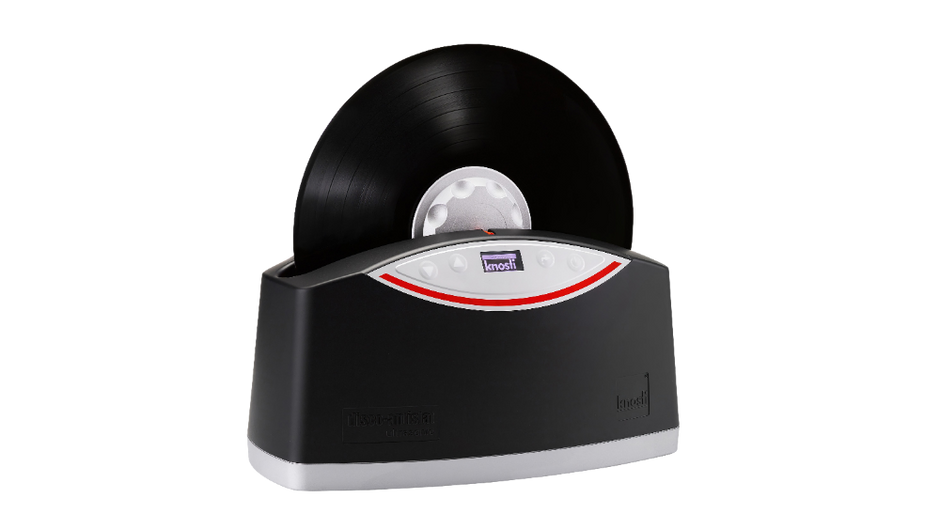


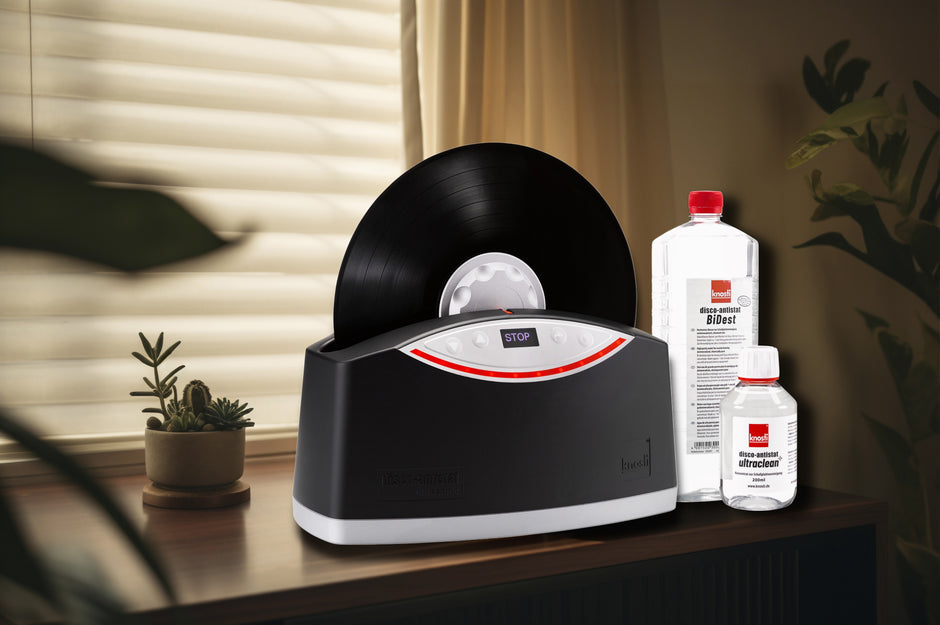


KNOSTI Disco-Antistat Ultrasonic 2.0 – clean now, don't wait.
The Disco-Antistat Ultrasonic 2.0 combines 46 kHz ultrasonic technology with proven goat hair brushes and permanent filtration of the cleaning fluid – for thorough and gentle cleaning of your records.
While others are drying, KNOSTI is already cleaning the next record.
KNOSTI deliberately foregoes integrated fan drying.
The advantage is particularly evident when you clean several records: after cleaning, the record simply goes into the drying rack and the next one can immediately go into the Ultrasonic 2.0.
Cleaning and drying run in parallel – instead of sequentially.
This prevents the machine from being blocked by an additional drying cycle.
Quiet drying instead of fan noise.
Since no drying fan is needed, there is no additional fan noise during drying. The device is very quiet in operation!
The records dry outside the device – while you are already cleaning the next one or simply listening to music.
At the same time, KNOSTI avoids continuously drawing ambient air over the freshly cleaned record surface for drying.
More than just ultrasound.
For KNOSTI, ultrasound alone was not enough. That's why the Ultrasonic 2.0 combines several cleaning principles:
46 kHz ultrasound + goat hair brushes + KNOSTI cleaning fluid with antistatic effect + permanent filtration.
During cleaning, the fluid is continuously filtered. The loosened dirt should not simply remain in the cleaning bath.
For individual favorite records. And entire collections.
If you regularly clean several records one after another, you particularly benefit from the KNOSTI principle:
Clean → remove → let dry → immediately clean the next record.
KNOSTI Disco-Antistat Ultrasonic 2.0
Clean thoroughly. Dry separately. Continue cleaning immediately.
Vinyl care since 1976. Made in Germany.
👉 Discover numerous test reports from renowned specialist media about Disco-Antistat Ultrasonic 2.0 here: LINK
Manufacturer: Knosti Phono-Zubehör-Vertriebs GmbH, Gewerbering 4, 86666 Burgheim Germany, E-Mail: info@knosti.de
Bitte beachten Sie unsere Widerrufsbelehrung .
Es gelten unsere Allgemeinen Geschäftsbedingungen (AGB) .
Couldn't load pickup availability
Pay securely
Fast shipping
Free Support

To fill the tank, you will need approximately 500ml of cleaning fluid. Be careful not to fill the tank above the "Max" mark – specifically, not above the brushes, and the sealing tray must not float in the water during filling. The water level may rise slightly during operation, and fluid may be forced up the sides of the tank, so it is important to ensure the correct fill level before starting the cleaning process. Also, keep in mind that different record sizes and pressing weights will affect the fluid displacement, and the required level of cleaning fluid may vary depending on the record being used.
Of course! Our first washing machine was
even specifically developed for the purpose of playing wet records without
to play without loss of quality. However, we would like to point out that
that with wet played records, several cleaning cycles may be necessary
are required to remove the caked-on dirt in the groove caused by wet running.
to completely remove dirt.
It is generally recommended to clean the washing machine after use before storing it away. It is also important to ensure that all components of the washing machine are completely dry before storing it, e.g., in the box. Cleaning should be carried out according to the included cleaning instructions.
To clean the tub of older Generation I washing machines (made before 2020) where the brushes cannot be removed, you will need approximately ½ liter of distilled water to rinse the tub. For Generation II Plus and Generation I washing machines manufactured from 2021 onwards, tap water can also be used to rinse the tub after removing the brushes from the housing. Soiling can be easily loosened and removed from the tub using a suitable brush or cloth.
Depending on the model, only use clean tap water or distilled water to clean the tub. Never use cleaning agents (e.g., soap, dishwashing liquid, chemical cleaners, etc.), as these may leave residue on the inside of the tub or damage the plastic/surface of the tub.
Always dry the housing, especially the inside, carefully with a cloth after rinsing with tap water to avoid residues (e.g. limescale) remaining in the cleaning tray!
Yes, this is
easily possible.
Absolutely! Even brand-new records are anything but clean!
Of course, a pressing plant isn't a clean room, but an industrial facility. Therefore, records often become contaminated during production. Paper fibers or dust from the inner sleeves can also transfer to the new record. You'll be amazed at the positive effect cleaning an LP freshly removed from its sleeve can have on the sound!
The rubber rings improve the adhesion between the protector and the record and reduce slippage during cleaning. They also provide a gentle cushioning effect, which can provide additional protection for the label surface and help distribute pressure more evenly—especially useful when using the crank or in automatic systems.
Dirt, such as dust, is best removed while dry with your fingers, a small brush (e.g., a nail brush), or a paintbrush. The brushes can then be rinsed with distilled water.
If your washing machine allows it, we recommend removing the brushes for cleaning, as this makes cleaning much easier.
As a general rule, you should clean all records with your Disco-Antistat cleaning device before playing them! Especially with used records, it's usually unknown how well they've been cared for, whether the LPs have been wet, or anything similar. This will hopefully ensure uninterrupted music enjoyment, as well as prevent unnecessary wear and tear on your record player.
Otherwise, cleaning your existing collection should be done as needed. There are a variety of factors that can play a role here:
- How carefully are the records handled?
- Is there any visible or audible contamination?
- What type of archiving was chosen?
- Do you smoke?
- Do you play the records often or rarely?
When in doubt, the rule of thumb "better once too much than once too little!" should apply, then you'll always be on the safe side.
To prevent the record from becoming dirty again, we strongly recommend replacing each cleaned record with a new inner sleeve to prevent dirt from the inside of the sleeve from transferring to the newly cleaned record. We recommend using sleeves lined with antistatic film. This prevents static buildup on the records and also prevents the occurrence of so-called "paper scuffs" (fine abrasions on the surface of the vinyl) or "hairlines" (very thin, small scratches) caused by removing or inserting the record into or out of the sleeve.
The brush holders are made of stainless steel sheet. Due to the mechanical processing, however, tiny machining residues from the tools may remain on the holders (especially on the inside). This cannot be avoided during production, despite the highest quality standards.
Contact with corrosive liquids, including tap water, can cause an immediate chemical reaction, and the adhering metal particles can oxidize (rust). This rust then becomes visible as flash rust on the ends and/or surface of the brush holders. Under certain circumstances, this may also lead to a brownish discoloration of the goat hair.
The use of cleaning agents other than the products we recommend, Disco-Antistat Mixture (Art. No.: 1301000) and Disco-Antistat Ultraclean (Art. No.: 1302000), can also lead to oxidation on the brush holders.
Furthermore, we recommend storing the device in its packaging after use only when the brushes are completely dry. Storing the device with wet brushes can also lead to oxidation on the brush holders.
Generally, the oxidation of the brush holders does not affect the functionality of the washing machine, so you can continue using your device without concern. In most cases, surface rust stains can be easily wiped off with the rough side of a dry sponge.
It may happen that one or both brushes are relatively tightly seated in the housing and cannot be easily removed. This is completely normal and has various causes.
The plastic from which the cleaning trays are made is subject to a certain tolerance when cooling. Therefore, slight variations in dimensions can occur within very narrow limits. This is most noticeable in the brush guides, as the brushes are somewhat more difficult to install or remove in the lower tolerance range.
We use only goat hair for our cleaning brushes. Since naturally grown products are never exactly identical, there may be differences between the hairs, for example, in terms of hair diameter, so the brush heads may have slight differences in their thickness.
As soon as the goat hair comes into contact with water, it absorbs water and swells. It's therefore perfectly normal that the brushes may be a little harder to remove or install when wet.
In this case, the use of suitable tools, such as combination pliers or water pump pliers, is required to remove the brushes.
Using the pliers, grasp the brush firmly by the bristles slightly above the center, as close to the brush heads as possible. Be careful not to touch the brush guide in the cleaning tub. Then pull the brush vertically upwards out of the guide.
This problem usually occurs with devices where the brushes are already somewhat tightly seated in the housing, and removal may have required tools. Keep a suitable 4 mm flathead screwdriver handy for this purpose.
Then try out the different ways of installing the brushes (swapping right/left, turning the brushes around); this often makes it easier to install the brushes.
If the problem persists, select the configuration that allows the brushes to be pushed into the tray with the least resistance and push the brushes into the guides by hand as far as possible. Then, using a screwdriver, push the brushes into the guides from above until the brush holder is completely recessed into the guides of the cleaning tray. Be careful not to damage the guides with the screwdriver.
If a brush can no longer be installed even with the use of tools, check whether the brush has become distorted (e.g., due to improper disassembly). To do this, place the brush on a flat surface, such as a tabletop, and check whether it is fully supported or possibly wobbling. Don't forget to place the brush on its back. If the brush has become distorted, you can simply try bending it back into its correct shape.
As a rule, wet labels are the result of a few easily avoidable operating errors:
In many cases, the cleaner level in the tub is simply too high, and the sealing cup is submerged in the cleaning fluid. In this case, simply pour some fluid out of the tub. In this context, also note the information under "How much cleaning fluid should be added to the tub?"
Often, the label cover is opened immediately after cleaning. This can cause any cleaning fluid still on the record to run over the label. To prevent this, hold the record at an angle of 30°-45° above the tray and wait until most of the cleaning fluid has drained from the vinyl. Once only a few drops of cleaner are dripping from the record into the tray, you can open the sealing tray and place the record in the drying rack for final drying.
Another common mistake is leaving the record wet while cleaning it in the tray. As long as the record rotates in the tray, the fluid runs along the groove to the right or left of the label. Once the rotation stops, it usually doesn't take long for the cleaner to run vertically down the record and collect at the edge of the label cover. This poses a risk that fluid could also get onto the label.
In most cases, the cleaner dries without leaving any residue on the record label, but depending on the material of the label, the printing ink used and other factors, stains, discoloration or similar may occur in individual cases.
Wählen Sie Ihre Sprache und laden Sie die passende Anleitung herunter.
